Bamboo vs. Rattan vs. Wicker vs. Cane: The Confusion Ends Here
Let’s play a game. Look around your home, or scroll through a furniture site. You’ll see “Rattan Chair,” “Wicker Basket,” “Cane Seat,” “Bamboo Shelf.” They’re all used to describe that lovely, textured, natural look. The words swirl around, interchangeable and confusing. Is that chair bamboo, rattan, cane, or wicker? Does it even matter?
Yes. It matters a lot.
I used to think they were just different names for the same vibe. Then I tried to build a chair with “bamboo” like my “rattan” one. It was a disaster. The materials behaved completely differently. That’s when I learned: this isn’t about synonyms. This is about four distinct things: two are materials, one is a part of a plant, and one is a technique. Many traditional cane craft traditions across India have relied on these distinctions for generations when working with natural weaving materials.
Mixing them up is like calling a wool sweater “knit,” a wooden table “carpentry,” and a cotton shirt “thread.” It’s not wrong, but it misses the point entirely.
Consider this your ultimate field guide. By the end, you’ll not only know the difference, you’ll see it everywhere. And you’ll never be fooled by a vague product description again.
The Quick-Answer Map (Save This)
Before we dive deep, here’s the cheat sheet:
- Bamboo: A material. It’s a hollow, woody grass. You get poles, planks, and strips.
- Rattan: A material. It’s a solid, vine-like palm. You get poles and the all-important inner core.
- Cane: Not a standalone material. It is the usable product made from rattan—specifically, the rattan’s smooth outer skin or inner core, peeled and woven into sheets or strands.
- Wicker: Not a material at all. It is the ancient technique of weaving flexible materials—whether rattan, cane, bamboo, willow, or even synthetic fibers.
So, a “wicker basket” could be made from “cane” which comes from the “rattan” plant. A “bamboo” shelf is just bamboo. Got it? Now, let’s get into the weeds (or the vines, rather).
Chapter 1: Rattan – The Solid Core
What it is: Rattan is a climbing palm vine native to tropical forests in Southeast Asia, Africa, and parts of Australia. It’s not a tree. It scrambles up other trees like a woody liana.
Key Identifier: It is solid all the way through, like a very long, skinny tree trunk. This makes it incredibly strong yet flexible. You can steam-bend it into curves for furniture frames.
What you buy: Whole rattan poles (used for structural frames of furniture) and rattan peel (the outer skin, often used for wrapping joints).
Think of it as: The oak tree of this story. It’s the source of strong lumber (poles) and a useful by-product (the bark/peel).
Chapter 2: Cane – The Product of Rattan
This is where most confusion lives. Cane is not a separate plant you grow. It is what you make from rattan.
When a rattan vine is harvested, two main products are created:
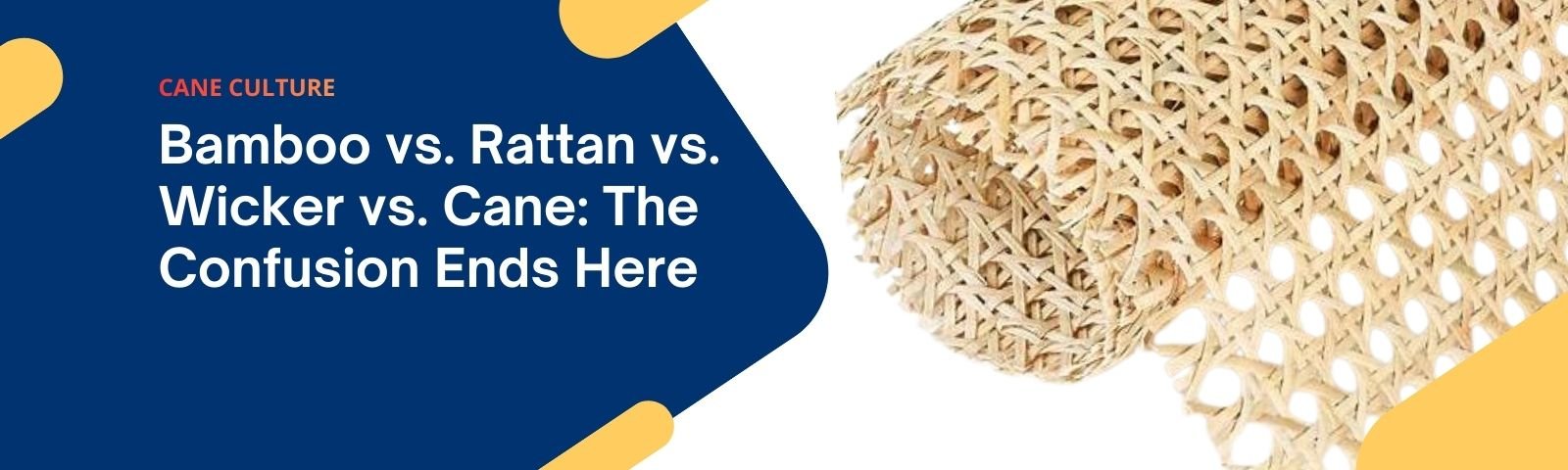
- Cane Webbing (Sheet Cane): This is the rattan’s inner core, split and machine-woven into those familiar, pre-woven sheets with the hexagonal pattern. This is what we sell as cane webbing rolls for chair seats and cabinet inserts. High-quality natural cane webbing is widely used for furniture restoration and decorative panels because it retains the strength of the original rattan core.
- Cane Strands (Binding Cane): This is the rattan’s smooth, shiny outer bark, peeled into long, flat strands. It’s used for hand-wrapping joints, making baskets, or for hand-weaving seats strand-by-strand (a more traditional, labor-intensive method than using pre-woven webbing).
Key Identifier: If it’s a thin, flat strand or a pre-woven sheet with that classic pattern, you’re looking at cane.
Think of it as: The plywood and veneer made from the oak tree. It’s the processed, usable sheet good derived from the raw material.
So, are rattan and cane the same? No. Rattan is the raw plant. Cane is the processed material made from rattan. All cane comes from rattan, but not all rattan is turned into cane (some is used as poles)
Chapter 3: Wicker – The Technique (Not a “Thing”)
This is the biggest myth. Wicker is not what something is made of; it is how it is made.
Wickerwork is one of humanity’s oldest crafts. It is the method of weaving flexible, linear materials—called “withies”—over and under each other to create a structure. It’s like saying “knitting.”
What can be “wickered”? Almost any pliable rod.
- Natural: Rattan cane, bamboo strips, willow, reed, raffia.
- Synthetic: Resin, vinyl, paper fiber.
Key Identifier: Any woven, basket-like texture on furniture. That chair with the thick, woven sides? That’s wickerwork, likely using whole rattan poles. That delicate basket? That’s wickerwork, possibly using cane strands.
Think of it as: The act of knitting. You can knit wool, cotton, or acrylic. The technique is “knitting,” the material is something else
Chapter 4: Bamboo – The Imposter (The Hollow Grass)
Bamboo is the odd one out. It’s an entirely different plant—a fast-growing, hollow grass. It is not related to rattan or cane.
Key Identifier: It is hollow between solid nodes (the bumpy rings you see). You can’t peel it into strands like rattan. It’s used as whole poles (for structure, stakes, blinds) or split into flat strips (for mats, baskets, and some weaves).
Performance: Bamboo is very hard but can be brittle. It doesn’t have the long-length flexibility of rattan, so it’s less ideal for tight steam-bending. It’s fantastic for solid, straight-line items like shelves, blinds, or poles.
The same material is also widely used in bamboo lighting designs that bring natural texture and warm light into modern interiors.
The Confusion: Because both are “natural” and “tropical,” cheap furniture often uses thick bamboo strips in a wicker weave and calls it “rattan style.” It’s not. It’s a wicker weave made from bamboo.
Side-by-Side Comparison: Durability, Use & Care
| Rattan (Pole) | Cane (Webbing/Strand) | Wicker (Technique) | Bamboo (Pole/Strip) | |
| What is it? | Solid palm vine. | Processed inner/outer bark of rattan. | Weaving method. | Hollow woody grass. |
| Best For | Structural furniture frames. | Chair seats, cabinet panels, hand-wrapping. | Creating woven textures on any scale. | Structural poles, flooring, blinds, flat strips. |
| Feel & Look | Smooth, woody poles. | Flat strands or pre-woven sheet with pattern. | Defined by the weave pattern, not the feel. | Hard, smooth, with visible nodes. |
| Durability | Very strong, flexible. Can last decades. | Strong when tight; can sag if loose. Can be re-webbed. | Depends entirely on the material used. | Very hard but can split at nodes; less flexible. |
| Care | Dust, avoid prolonged damp. | For webbing: dust, avoid direct sun & spills. | Dust carefully; depends on core material. | Wipe clean; can be used outdoors if treated. |
For outdoor furniture or high-moisture environments, artificial cane webbing offers the same woven appearance with better weather resistance.
How to Shop Smart and Do It Yourself
“Rattan wicker chair” means “good” (technique + material).”Rattan chair” probably means a chair made of rattan poles. “Cane seat” means a seat made of cane webbing.
If it just says “wicker,” ask what the core material is. Is it made of rattan, bamboo, or something else?
A clear comparison of natural vs artificial cane webbing helps buyers choose the right material depending on durability, location, and maintenance needs.
Conclusion
Want a frame that is strong and flexible? Search for rattan poles.
Need to re-cover a chair seat or make a panel? You need cane webbing.
Do you want to learn how to weave? You can buy strips of bamboo or cane.
Are you making a shelf or a straight pole structure? Bamboo is a great choice.
The Last, Simple Truth
You’ll be able to read a beautiful piece like a pro the next time you see one.
When you see a chair, you’ll think, “Ah, a rattan pole frame with a cane webbing seat and wickerwork details on the back.” Good.
You’ll see a basket and know, “That’s wickerwork made from bamboo strips.”
This information is useful for more than just winning trivia nights. It helps you get the right materials for your project. It helps you take good care of your furniture. It helps you understand the art better.
You are not confused anymore. You know. And that’s the best place for a shopper, a DIYer, or a design lover to be.
Now that you know a lot about the source material…
Check out our main product: real Cane Webbing, which is the processed inner core of the rattan vine and is made to be strong and beautiful. You can shop with confidence because you know exactly what you’re getting.
Browsing a cane webbing materials collection makes it easier to choose the right weave, size, and material for your project.