Secrets of the Craft: A Day with Mohsin, the Master Cane Weaver
You wouldn’t expect to find the workshop there. It’s in a quiet part of the city, up a narrow staircase, and behind a busy market lane. The sound of the street fades away, and a new rhythm takes its place: the soft tap-tap-tap of a small hammer, the rustle of dry cane strands, and the occasional, satisfying ping of a strand being pulled taut.
This is where Mohsin does his job. He has been weaving canes in the traditional way for more than 40 years. His hands, which are marked with the faint lines and strength of his craft, move with a thoughtless precision that only comes from doing something over and over again. He isn’t just fixing chairs; he’s talking to the wood.
I went to his workshop not only to see how it’s done, but also to learn why it’s done that way. What keeps a man at this quiet bench, learning a skill that many people say is going away? In a world of quick fixes and furniture that can be thrown away, what keeps him there?
What follows is a talk about patience, the soul in handmade things, and the quiet pride that comes from doing work that lasts longer than you do.
On Learning: The Unspoken Language of Hands
“Nobody sits you down and teaches you,” Mohsin says, not looking up from the chair frame he’s assessing. “You watch. For months, you just watch. You sweep the floor, you fetch tea, you sort the cane. Your eyes learn before your hands do.”
He learned from his uncle, who learned from his father. It was never a formal apprenticeship with certificates. It was a transmission, a passing of a silent language from one pair of hands to another.
“The first time you are given a piece of cane and a simple frame, you think it is easy. You pull, you staple, you think you are finished. Then your master taps the seat. Tup-tup. It sounds wrong. Loose. Like a tired drum. He doesn’t say anything. He takes it apart in front of you. That is the lesson. The cane must sing when you tap it. That is the only rule that matters.”
On the Material: Feeling the Life in the Cane
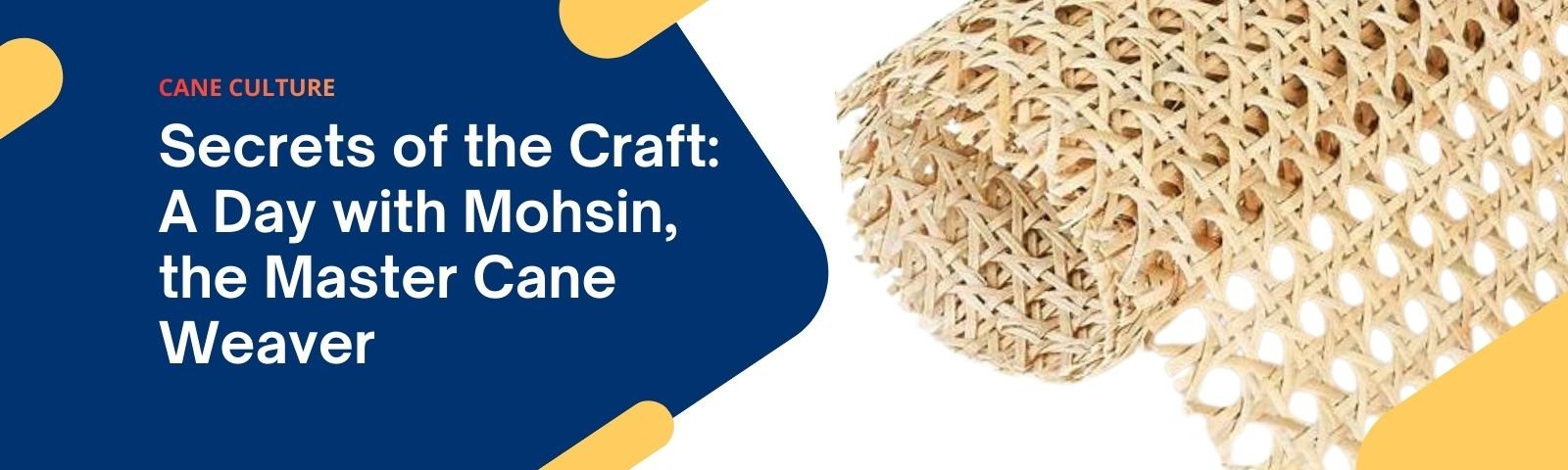
For Mohsin, the cane is not an inert product. It’s a living thing with memory. He picks up a strand of natural cane webbing, feeling it between his fingers. High-quality natural cane webbing responds better to careful soaking and tension, which is why experienced craftsmen are particular about the material they use.
“You must understand its mood. On a dry, hot day, the cane is stubborn. It wants to crack. You must be gentle, coax it. You give it a little water, you let it remember it was a plant. On a humid day, it is soft, willing. But you must still be the boss,” he smiles. “Your hands must know the difference.”
He dismisses synthetic cane with a gentle wave. “Plastic is dead. It has no memory. Artificial cane webbing, however, serves a practical purpose in outdoor or high-moisture spaces where durability matters more than tradition. It does not breathe. It is for outside, for rain. That is its job. But for a chair a man will sit on for thirty years? For something that becomes part of a family? You need the real thing. It lives with the house, with the air. It tightens, it loosens a little, it talks.”
Understanding the differences between natural vs artificial cane webbing helps beginners choose the right material for their specific project and climate
On the Process: Where the Magic Isn’t Magic
I ask him for the one secret, the trick that amateurs like me always get wrong. He laughs, a short, warm sound.
“The secret is there is no secret. Only steps you cannot skip. You think the secret is in the weaving? No. The secret is in the cleaning.”
He points to the old, broken cane seat he has just removed from a vintage chair. “Look at this groove. See here? A little bit of old glue, a speck of dirt. If you put new cane over that, it will never sit true. That one speck will make a weak spot. The whole seat will fail because of a speck you were too lazy to pick out.”
He takes a small, hooked tool, like a dental pick, and meticulously scrapes the century-old groove clean. It takes ten minutes for one section. “This,” he says, “is the work. The weaving is the reward.”
On Speed & The Modern World
In an age of next-day delivery, how does a craft measured in days, not minutes, survive?
“People bring me a chair their grandfather bought,” he says. “It is broken. They say, ‘Uncle, can you fix it fast? I have guests coming.’ I tell them, ‘Your grandfather waited for this chair. Your guests can wait for it to be fixed properly.'”
He is not being difficult. He is stating a fact of physics and craft. The cane must be soaked. It must be fitted, strand by strand, under even tension. It must dry slowly, tightening itself over days. Rushing any step is an insult to the material and a guarantee of failure.
“Today, everyone wants fast. Fast food, fast fashion, fast furniture. But some things cannot be fast. Trust cannot be fast. Strength cannot be fast. This chair,” he pats the frame, “will be fast only in breaking if I am fast in making it.”
On The “Dying Craft” and New Hope
This is the question that hangs in the air. Is he the last of his kind?
He is quiet for a moment. “When I started, there were five workshops on this lane. Now, there is mine. The young boys, they want to work on computers, in shops. This work is slow. It is hard on the back, the eyes. It does not make you rich.”
But then he gestures to a small pile of cane webbing rolls in the corner, the same premium material we supply at Cane Culture. “But now, something is changing. I see it. People like you come. Not just with old chairs, but with new ideas. They want to learn. They buy good cane, not the cheap, brittle stuff. They want to make headboards, room dividers, lamps.”
A spark enters his eyes. “This is good. This is how it lives. Not just in fixing the old, but in making new things. The craft does not care if it is a 100-year-old chair or a new shelf. It only cares that it is done right. When a young person comes with respect for the material, the craft feels young again.”
One last piece of advice for everyone who tries
As I get ready to leave, the smell of cane dust and old wood fills the air. I ask him for one piece of advice for someone who is picking up cane webbing for the first time.
He thinks, wiping his hands on his apron. “Don’t fight it. You are not its enemy. You are in a partnership. You are making it stronger. You have already lost if you are fighting, pulling too hard, or getting mad. Your anger goes into the fabric. The seat will feel mad. Sit down with it. Be patient. “Let your hands learn its language.”
“Begin with a small stool. Not the chair your grandmother loved. Make your mistakes where they won’t hurt you. And always, always get the best cane you can afford. Good material is easy on a beginner’s hands. “Bad material breaks everyone’s heart.”
As I walked back out into the noisy lane, the tap-tap-tap sound fading behind me, the lesson was clear. What Mohsin sells isn’t a service. It’s honesty. It’s a deep understanding that the way you do something is just as important as the thing itself.
That piece of natural cane webbing you have isn’t just a sheet of plant fiber. It’s a possible vessel for that same respect and patience. It asks you to be a part of a story that is much older than you.
Did Mohsin’s work with his material give you ideas?
Start your own journey with the same level of quality he expects. Exploring premium cane webbing and tools in one place makes it easier to begin your craft journey with confidence and the right materials. Look through our selection of high-quality natural cane webbing and tools. Make something beautiful that will last.